

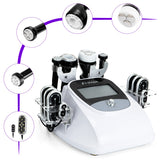


What Is Hydro Dermabrasion — and What Does the Evidence Support?
Hydro dermabrasion (hydradermabrasion) is a generic technique, not a brand: surface dead cells are lifted under negative pressure and a fluid stream while a water-based solution is applied in the same pass (PMC: PMC4155739). Its defining feature is that exfoliation and water delivery happen together, which is the main difference from dry crystal or diamond-tip microdermabrasion (PMC: PMC4155739). Our hydro dermabrasion facial overview covers the full mechanism.
The published evidence is real but small. A randomised study of 20 women over six sessions reported changes in skin thickness and antioxidant markers with no complications, and the authors themselves flag the limited sample (Freedman 2008, PMID: 19146604, DOI: 10.1111/j.1473-2165.2008.00406.x). An 8-subject imaging study observed visible erythema settling over 2–5 days after light-to-moderate treatment (Razi 2024, DOI: 10.1111/srt.13684, PMC: PMC10983707). Neither is a head-to-head comparison of home and salon devices, and the AAD describes microdermabrasion results as temporary and usually delivered as a series (AAD microdermabrasion FAQs). For how the technique sits next to dry microdermabrasion, see hydradermabrasion vs microdermabrasion.
How Does a Home Device Compare With a Professional Treatment?
The practical differences are not marketing claims; they are differences in control, process and responsibility.
| Dimension | Home device | Professional salon treatment | What it means for your service menu |
|---|---|---|---|
| Device adjustability | Typically a limited set of presets for suction and fluid flow | Broader adjustable ranges, multiple handpieces and tips; exact settings follow the product page and user manual | You can match settings to skin and response instead of accepting a fixed pass |
| Hygiene and cross-infection | One user, but cleaning still depends on the owner; sharing a unit between people reintroduces cross-infection risk | Documented between-client protocol for tips, tubing and work surfaces | A protocol, not a feature, is what you are selling |
| Per-session cost structure | Device cost plus consumables, borne by one household | Device cost, consumables and variable per-session costs spread across client flow, priced as a service | Model your own numbers; do not quote a universal per-session figure |
| Who operates | The user assesses their own skin and selects settings | A trained operator screens, sets parameters and watches the response | Assessment is part of the service, not an accessory |
| Risk boundaries | Contraindications are easy to miss without intake | Screening and "stop" decisions sit with the operator | Your intake form is the real safety device |
| Best fit | Convenient maintenance between visits | Varied skin types, first-time clients, anyone needing assessment | Position home units as maintenance, not replacement |
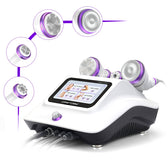
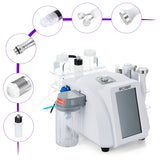
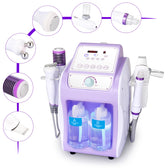
Price positioning runs from entry-level home units through compact and full-size professional configurations; compare current listings and your own menu rather than fixed figures. Adjustability is the clearest technical divide: professional units generally offer a wider range of suction and fluid delivery and more tip options, while specific parameters should always be read from the product page and user manual. That range matters because skin and responses vary, and because a one-setting-fits-all pass cannot account for a reactive client or a darker skin tone that warrants professional evaluation (AAD, Chemical peels: FAQs).
Why Does Who Operates the Device Change the Risk?
A professional treatment is defined as much by the person running it as by the machine. In your salon, the operator takes the intake, chooses the settings, watches the response and decides to stop — decisions a home user has to make about their own skin, often without a screening framework.
That is why the postponement list belongs in your intake process, not in a leaflet. Postpone and refer for assessment if a client has used isotretinoin within the last six months, has a growing, bleeding or changing lesion, a keloid or abnormal-scarring tendency, an active skin infection, open wound or herpes outbreak, an active rosacea or inflammatory acne flare, a known allergy to a solution ingredient, or is pregnant or breastfeeding — safety data in pregnancy are insufficient, so the advice is to delay and consult a doctor (AAD, Microdermabrasion: FAQs; AAD, Chemical peels: FAQs; AAD, Is any acne treatment safe to use during pregnancy?). The full contraindication and aftercare picture is covered in who should avoid hydro dermabrasion.
Hygiene is the second process difference. No device prevents infection by itself; a documented between-client routine for tips, tubing and work surfaces is what reduces cross-infection risk. Present it as a step you perform for every client, not as a property of the equipment.
How Should You Think About Cost per Session?
Avoid quoting a universal per-session figure. The honest cost structure has three inputs: what the device costs to buy, what each session consumes in solutions and disposable parts, and how many paying sessions actually run through the chair. The rest is your pricing decision.
If you want an example model, the standard payback expression is:
payback (weeks) = device price ÷ [sessions per week × (price per session − consumables per session − variable cost per session)]
This is an illustrative calculation only. List every assumption, and note that it excludes labour, rent, marketing, tax, depreciation and financing costs; the real result depends on your pricing, client flow and operating costs. Do not attach a fixed number of weeks to it. To compare configurations before you build the model, browse the hydro dermabrasion machine collection and price each option against your own menu rather than against a competitor's claim.
What Do Safety and Regulation Actually Say?
Regulation language is where salons most often overstate a device. The FDA states that whether an aesthetic device is regulated depends on its intended use, and that results may be less than expected, may be temporary and carry risks (FDA aesthetic device guidance). A 510(k) clearance is a premarket notification of substantial equivalence; it is not FDA approval of efficacy (FDA 510(k) clearance explanation). Dermabrasion devices sit in Class I and are 510(k)-exempt in many cases under the device-class rules — that is a classification, not a clearance certificate for any particular model (FDA, 21 CFR 878.4820). Do not imply regulatory approval of efficacy; describe the device class and intended use, and point clients to the official label for the specific model.
How Do You Explain the Difference to a Client?
Keep it short and non-defensive. The line that works is: the technique is the same, but the control, the hygiene process and the person responsible for screening are different.
- "Both use water and suction to exfoliate. The difference is how much the operator can adjust for your skin and who is watching the response."
- "A home device is convenient for maintenance between visits; it does not replace an assessment before a first treatment."
- "Our hygiene routine is a documented step we perform for every client — it is not something the box guarantees."
- "We describe devices by class and intended use, not by an approval claim; a clearance is not an efficacy claim."
- "You are paying for a service — assessment, settings and aftercare — not only for machine time."
Frequently Asked Questions
Is a home hydro dermabrasion machine as good as a salon treatment?
They use the same basic technique, but they are not interchangeable. A salon unit offers wider adjustability, a between-client hygiene protocol and a trained operator; a home unit offers convenience. Small studies support the technique itself, not a home-versus-salon equivalence claim.
Can a home device cause the same side effects?
Yes, because the mechanism is the same. Visible redness, tightness and slight swelling are common and usually settle; the AAD records microdermabrasion pinkness settling within about a day, while moderate hydro passes can show erythema for 2–5 days (AAD, Microdermabrasion: FAQs; Razi 2024, DOI: 10.1111/srt.13684, PMC: PMC10983707).
How can I tell whether a salon device is regulated?
Ask about intended use and the device class rather than expecting an "approval" claim. A 510(k) clearance is a substantial-equivalence notification, not FDA approval of efficacy, and regulation depends on intended use (FDA, 510(k) Clearances; FDA, Aesthetic (Cosmetic) Devices).
Why does a professional session cost more than doing it myself?
Because you are paying for assessment, adjustable settings, a hygiene protocol and aftercare advice, not just machine time. There is no universal per-session figure; cost depends on the device, consumables and client flow, so ask your salon how its price is built.
How often should I book a professional treatment?
A common plan is a series of 4–6 sessions spaced 2–4 weeks apart, adjusted for your skin, response and your operator's assessment — not a fixed promise. Your operator should decide spacing at review, and temporary results mean maintenance matters.
Where to Go Next
- Hydro Dermabrasion Facial overview
- How hydradermabrasion differs from microdermabrasion
- Hydro dermabrasion side effects and who should avoid it
- Compare professional hydro dermabrasion machines
- Brand systems vs generic treatments


0 comments