



You booked a deep-cleansing facial expecting to leave glowing. Two mornings later there are three new bumps on your cheek, and the spa's reply is instant: you're purging, it's detoxing, give it a week. Sometimes that's right. But for many day-two breakouts after a facial, the better explanation is two things nobody mentioned: how the handpiece was set, and what landed on your skin in the next 48 hours.
Worrying is reasonable. "Wait it out" is a weak answer when you have an event on Saturday. Here are four questions to sort any post-facial flare into a true purge, an irritation response, or acne that was coming anyway, then a timeline, a 72-hour plan, and a red-flag list.
If you're up late typing “is it normal to break out after a hydro dermabrasion facial”, how to tell if you're purging or breaking out decides your next move.
One boundary first: this is general education, not medical advice. The triage below is a decision tool for choosing a next step, not a diagnosis. If anything persists, worsens, or worries you, contact your provider or a dermatologist.
Why "It's Just Your Skin Detoxing" Is Usually the Wrong Answer
Purging has a specific meaning: something speeds up cell turnover, and the microcomedones under the surface come out faster than they would. It's a conditional word: it assumes something was already there.
That condition matters for a practical reason: once a mechanical or irritant response gets labeled "purging," the advice is to wait it out, and that's wrong when what you're waiting on needs stopping. The protocols reviewed for this piece describe 7 to 10 days of paused actives and simplified care as the response.
To be fair, plenty of clinics say the opposite - that post-facial breakouts are almost always a purge. True purging does happen. So we're not arguing that purging is fake. We're arguing that the label gets used when its preconditions aren't met - and most day-two breakouts after a facial don't meet them.
One honest caveat: the published literature on post-facial flares is thin - mostly clinic protocols and expert Q&A, not controlled trials. That's why the four questions below lean on what you can actually see, rather than on a label someone else hands you. And even where a treatment course helps acne over several weeks, that says nothing about what one session does in the next 48 hours.
The Four-Question Triage: Classifying Any Post-Facial Breakout
Instead of asking "is this a purge?", ask four narrower questions. Call it a post-facial lesion triage:
- Baseline. Did that area already have visible non-inflammatory comedones, meaning blackheads and closed bumps? For background, see hydro dermabrasion protocols for acne-prone skin.
- Morphology. Small superficial whiteheads, or uniform pink papules and pustules?
- Distribution. Your usual jawline and chin, or somewhere you never break out?
- Time course. Fading on their own, or still arriving?
Purge vs. irritation after a facial, side by side:
| Signal | Looks more like a true purge | Looks more like a mechanical or irritant reaction |
|---|---|---|
| Baseline | Blackheads or closed comedones already there | That area was clear when you walked in |
| Lesion type | Small superficial whiteheads that surface fast (whiteheads vs papules after treatment) | Uniform small papules and pustules |
| Distribution | Usual jawline and chin | A new area (cheeks, temples, hairline), often a patch |
| Time course | Self-limited; settling within a week | Still appearing or spreading past day seven |
| How it feels | Mild tenderness when touched | Stinging, burning, tightness, itch, redness |
| Response to pausing actives | Gradually calms on a bland routine | No change, or keeps getting worse |
A hydrodermabrasion purge is a short flare that meets four conditions at once: non-inflammatory comedones were already visible before your appointment, the new lesions are small and superficial, they sit where you normally break out, and they clear within about a week. Everything else earns a different plan, and telling a purge from a breakout is what the four questions are for. No mirror squinting required.
Holding the handpiece? Four columns on your intake form.
The Timeline - Day 1, Day 2, Days 3-7, and Beyond Day 7
Appearance misleads; the clock doesn't.
- 0-24 hours. Mild pinkness and tightness are common. Anything you see tonight is too early to classify. Don't call it anything yet.
- 36-72 hours. The window that matters. In the clinical Q&A we reviewed, post-facial papules and redness were described as acute irritant or contact dermatitis, with improvement expected within 48 to 72 hours once actives are stopped and the routine simplified.
- Days 3-7. A genuine hydrodermabrasion purge should be winding down here. True purging runs three to seven days in one source, five to seven in another.
- Past day seven. Still arriving, spreading, or unchanged? None of the timelines we checked still calls that a purge.
Search “how long does skin purging last after a facial” and you'll get two answers that can't both be right. Dermatologists usually mean one thing by "purging": active ingredients like retinoids and acids, running four to six weeks, roughly one skin turnover cycle (a dermatologist-reviewed guide to purging versus breakout). The post-procedure sources mean something much shorter. Both can be accurate, and they aren't the same mechanism.
The two numbers, and what each one means: a post-procedure flare runs about 3 to 7 days; active-ingredient purging from retinoids or acids runs about 4 to 6 weeks.
Where Breakouts After a Hydro Dermabrasion Facial Come From: Five Mechanical Triggers
A hydro dermabrasion handpiece works several ways at once: vacuum, controlled exfoliation, serum delivery.
- Vacuum suction and exfoliation pressure. Mechanical stress on the follicle wall produces papules indistinguishable from acne, and it's the trigger your provider can change. For the mechanics, see hydradermabrasion vs microdermabrasion.
- Occlusion and friction. Pillowcases, hats, masks, sports gear, your phone. A week-old pillowcase on freshly exfoliated skin is a real exposure.
- Heat. Steam, hot showers, hot yoga, saunas. Heat plus sweat plus occlusion reliably irritates skin that was just worked over.
- Serum or booster intolerance. These itch, and they show up where the product went, which is why it's worth writing down which serum you used.
- Over-aggressive aftercare. The "I need to clear this up" spiral: acids, retinol, a scrub, then a clay mask within 48 hours.
Bumps from friction or heat land in the same structures acne does - oil, bacteria, dead cells, hormones, all of it (AAD: what causes acne). That's why contact dermatitis after facial treatment gets misread so consistently.
Breakouts After a Hydro Dermabrasion Facial: Your First 72 Hours
One principle covers this section: make your routine boring. Your skin just had things done to it.
- For three days, your whole routine is three products: gentle cleanser, moisturizer, broad-spectrum SPF.
- Pause actives for 7 to 10 days - retinoids, AHAs and BHAs, high-strength vitamin C, scrubs. Rebuild later with an acne routine matched to your skin type.
- Don't pick, squeeze or extract. You'd trade a bump that resolves for a mark that lingers.
- Skip heat and heavy sweat for 24 to 48 hours - hot yoga, saunas, hard workouts. The core of what to avoid after a hydro dermabrasion facial: workout, heat, makeup.
- Go light on makeup the same day, or at least until the pinkness settles.
- Wash what touches your face - brush heads, phone screen, the pillowcase.
Hydro dermabrasion facial aftercare, the avoid list in one line: no actives for 7 to 10 days, no heat or heavy sweat for 24 to 48 hours, no picking or extraction, no same-day heavy makeup, and nothing unwashed touching your face.
The hardest item is the one that costs nothing: adding a product feels like doing something, and doing nothing feels like neglect. But 7 to 10 days without active ingredients is the intervention. No improvement after 48 to 72 hours? Stop troubleshooting and call the spa.
Red Flags: When to Stop Waiting and Call Someone
Most post-facial flares settle. Here's when to contact your provider after a facial, and what to bring:
- Past seven days, no improvement, or still worsening. Seven days is the outer edge in the sources above.
- A rash-like patch or diffuse redness rather than discrete bumps. That reads more like contact dermatitis than acne.
- Cystic lesions: deep, painful, under the surface. Don't wait on these. Have your provider or a dermatologist take a look.
- Visible barrier damage: tightness, flaking, products stinging on contact.
- Anything you're genuinely worried about. Not a formality: if you're reading this at midnight, you've earned the call.
Bring four things and you'll get a real answer, not a guess: the treatment date, one line on your skin that morning, a daily photo in the same light, and everything you applied in the next 72 hours. Then ask them to re-check the suction setting and serum, and their sanitation steps.
If you have darker skin, there's one more reason to leave a spot alone. Dark mark risk rises with how deep the inflammation goes and how much you pick, so post-inflammatory hyperpigmentation after picking is the outcome to avoid. The AAD covers it: AAD: acne care in skin of color.
For Estheticians & Spa Owners: Protocol Adjustments That Reduce Mechanical Reactions
Suction level, serum strength, and whether you extract aggressively are the three variables on your side of the room. Set them by barrier status, and write them down.
1. Set intensity from the baseline, not the menu
A client with heavy visible comedones and an intact barrier, versus one who started a retinoid three weeks ago: same service, different settings. The second gets a shorter pass and lower suction.
2. Skip aggressive extraction over active cystic acne
Move to a gentle protocol or reschedule: it's the clearest cut to mechanical risk available to you.
3. Turn suction into a number you can write down
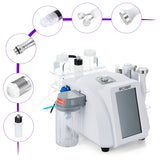
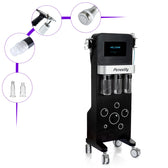
"About halfway" isn't reproducible across shifts. Adjustable suction levels on a hydro dermabrasion machine help: the Compact 8-in-1 Hydro Dermabrasion System synchronizes water flow and vacuum across 0 to 5 levels and locks the water-to-suction ratio, with a 7-inch touchscreen that centralizes parameters. The manufacturer says that minimizes adjustment errors. Maximum negative pressure is -65 kPa; four diamond tips are included.
4. Use interchangeable tips instead of one intensity across the whole face
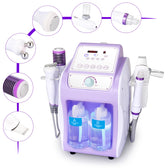
The 8-in-1 Vertical Hydro Dermabrasion System takes interchangeable hydro and diamond tips on its hydro handle, plus a silicone tip for scalp work; its oxygen sprayer, which the manufacturer calls ideal for post-treatment care, is one route to oxygen spray for post-treatment calming. The 21 kg cabinet holds four handles.
5. Write the aftercare down, and write your settings down
Hand over the 72-hour avoid list and the 7 to 10 day actives pause in print, and log your parameters. That's what lets you compare this visit to her last one when she calls.
None of this is a promise - it's documentation. Recording suction settings against barrier condition gives you something to reason from next time. It isn't an acne treatment, and it doesn't guarantee an outcome.
FAQ
Is it normal to break out one or two days after a hydro dermabrasion facial?
Common enough that every clinic fields the call - but "common" and "purging" aren't the same claim. A day-two flare is too early. Run the four questions instead.
How long should a real purge last, and why do I see both "3 to 7 days" and "4 to 6 weeks"?
Because they describe different mechanisms. Post-procedure sources put a true purge at three to seven days, or five to seven in another; dermatologists put active-ingredient purging at four to six weeks. Past the longer one, stop calling it a purge.
Can I keep using retinol, acids or vitamin C after my treatment?
Short answer: no - pause them. Here's why: the clinical Q&A we reviewed recommends 7 to 10 days without active ingredients for suspected irritation, plus a cleanser-moisturizer-SPF routine. Retinoids, acids, high-strength vitamin C and scrubs all fall in that pause.
The bumps are on my cheeks and temple, but I never break out there. What does that mean?
Distribution is your strongest single clue. A purge surfaces congestion that was already there, so it shows up where you're normally congested. Elsewhere, bumps read as mechanical instead.
I have darker skin. Should I worry about dark marks after these bumps?
The bump will pass. What you do to it is the part you control - and the part that decides whether a dark mark stays. That risk rises with how deep the inflammation goes and how much you pick. So the move is: leave it alone, wear broad-spectrum SPF, calm the inflammation.
I'm an esthetician. Should I still treat a client with active cystic acne, and what do I change?
Don't extract over an active cyst. Use a gentler pass, or move the appointment: it's the single clearest way to cut mechanical risk. Then adjust suction, serum strength, and documented settings. A "baseline comedones" column makes acne-prone skin and suction settings reviewable next time.
The Bottom Line
So don't panic about breakouts after a hydro dermabrasion facial, and don't let anyone wave them off either. Name what you're looking at, and the name tells you whether to wait, strip your routine back, or pick up the phone.
If you're the client: make your routine boring for 72 hours, give it seven days, and escalate if it's still worsening. If you're the professional: put the four triage questions in your intake form.
Standing caveat: this is general education, not medical advice. Persistent, worsening or cystic changes belong with your provider or a dermatologist.


0 comments