

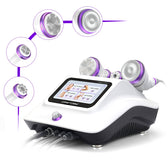
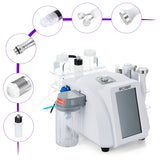
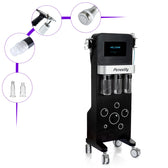
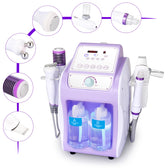
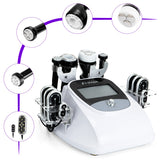

The short answer up front: focused and radial are two different ways of generating and delivering a pressure wave. One is not an upgraded version of the other, and neither has a fixed depth or a "better results" ranking. These are professional cosmetic and wellness devices for trained operators; whether one is regulated as a medical device depends on its intended use and effect on bodily structure or function, as the FDA sets out for aesthetic devices.
Two different ways of making a wave
The distinction is in how the wave is produced and how it travels, not in a quality grade.
Radial (also called ballistic) systems use compressed air to accelerate a projectile inside the handpiece. The projectile strikes the applicator, which transfers a pressure wave to the skin. The wave spreads outward from the surface — it diverges — so energy is strongest near the applicator and over a broader area. Radial units commonly ship with several head sizes for different body zones.
Focused systems generate the wave at a source — electromagnetic, piezoelectric or electrohydraulic — and use a applicator geometry or water coupling to converge the energy toward a focal zone inside tissue. The energy is directed at a defined target rather than spread from the surface.
That is the real, defensible difference: a diverging wave that is broader and shallower, versus a converging wave that is targeted and deeper. Everything beyond that sentence in most comparison tables is where the trouble starts.
The claims that don't hold up
"Radial reaches 3 cm, focused reaches 12 cm"
Fixed penetration figures are everywhere, and they contradict each other from one site to the next — you will see radial quoted as 0–3 cm, 3–4 cm or 3–7 cm, and focused as 70 mm, 10–12 cm or 12 cm. There is no single number that applies to a category. Real penetration depends on the specific device, the applicator, the energy setting, the coupling and the tissue involved. Clinical references deliberately describe dose with energy flux density (mJ/mm²) or peak pressure (bar), not with one depth figure (Physiopedia, ESWT dosage). Treat any single centimetre number as a sales shortcut.
"Low Hz reaches deep tissue, high Hz tightens the surface"
Frequency in hertz is pulses per second. It is a dose and timing parameter, not a depth setting and not a results grade. The "low frequency = deep repair / high frequency = surface tightening" scheme appears on supplier sites but is not supported by the clinical literature. When you compare machines, ask about energy flux density, bar range and pulse count — not just an Hz maximum.
"Focused is the professional one; radial is for home use"
Both are used in professional settings. Radial systems are the mainstay of many physiotherapy and salon menus precisely because they are versatile and cover broad areas; focused systems are chosen when a practitioner wants a directed application. One large review of 46 ESWT studies noted that the applications were heterogeneous and the technical standards inconsistent — a reminder that the category resists simple hierarchies (Wigley et al., 2022). There is even active debate over whether radial waves should be called "shockwaves" at all, given their much lower peak pressures (Physiopedia). Neither fact makes radial a toy.
"Radial and focused work on different problems, so one is stronger"
Clinical evidence does support different use patterns: a 2024 systematic review found that, in Level I studies, ESWT may help in selected sports injuries such as plantar fasciitis and lateral epicondylitis, often as an adjunct to exercise (Rhim et al., 2024). But that body of work does not translate into a clean "focused wins" verdict for salon aesthetic services. For cellulite and contouring specifically, the same 2022 review above concluded the evidence was insufficient to support any specific intervention. So the honest position is: different tools, different applications, no blanket winner.
Shockwave vs cavitation vs RF — three different energies
This comparison gets muddled because all three appear on body-treatment menus. They are not interchangeable.
| Technology | Energy delivered | How it interacts with tissue | Typical salon framing |
|---|---|---|---|
| Shockwave (ESWT) | Mechanical pressure wave | Repeated pressure pulses; adjunctive, course-based | Supportive body and wellness service |
| Cavitation (low-frequency ultrasound) | Ultrasound waves producing bubble activity in tissue | Frequency- and power-dependent; distinct mechanism | Body-contour menu item |
| Radiofrequency (RF) | Electrical energy converted to heat | Controlled heating of tissue | Skin-tightening and contour menu item |
The useful point for a buyer is that these technologies can complement rather than replace one another on a menu. What you should not do is describe a shockwave unit in the language of RF heating or cavitation fat-reduction claims. If a supplier's page seems to promise all three from one handpiece, ask for the documentation.
So — which one should you choose?
Choose by the work, not by a hierarchy:
- Broad, general body-wellness services, multiple areas, one operator or a small team: a radial system with a set of applicator heads is the practical fit. It covers more surface, is usually more compact and is the lower-commitment entry.
- A targeted application in an established practice, with training and budget to match: a focused system gives you a directed tool and a point of difference.
- A menu that already includes RF or cavitation: treat shockwave as an adjunct with its own positioning rather than a replacement; keep each technology's claims accurate.
Whatever the type, verify applicators, energy specifications, consumable costs, training and warranty in writing. The buyer's guide by salon type turns that into a checklist, and the cost guide covers the ownership side. For the underlying physics and evidence, start with What Is Shockwave Therapy.
FAQ
Is focused shockwave actually stronger than radial? Not in any blanket sense. They deliver energy differently. Focused directs energy toward a target; radial spreads it over a broader, shallower area. "Stronger" depends on the application, and clinical evidence does not support a simple ranking for salon services.
Why do different websites give different depth numbers? Because there is no single category figure — it varies by device, applicator, setting and tissue. Sites quoting one number are simplifying. Ask for the specific energy and applicator specifications instead.
Does a higher Hz setting mean a better treatment? No. Hz is pulses per second, a dose parameter. Energy flux density, bar and pulse count are more informative, and outcomes also depend on technique and client response.
Can one clinic own both types? Yes. Some practices run radial for general work and focused for targeted applications. That is a commercial decision driven by your menu and case mix, not a sign that one type is incomplete.
Where to go next
- What Is Shockwave Therapy? What It Does and What the Evidence Supports
- Professional Shockwave Machines: A Buyer's Guide by Salon Type
- Who Should Not Use Shockwave Therapy? Contraindications and Screening
- Shockwave Therapy Machine Cost: What Salons Really Pay For
- Browse radial and focused shockwave machines — see which units use which wave type.


0 comments