

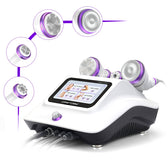
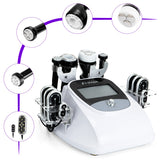

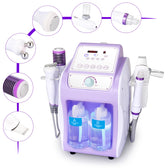
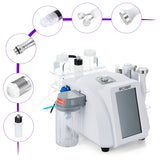

Which hydro dermabrasion machine fits your budget and service menu?
Start with the service, not the spec sheet. Hydro dermabrasion (hydradermabrasion) is a generic technique category: it lifts surface debris under vacuum while delivering water-based solutions, exfoliating and hydrating in one pass. HydraFacial® is a registered, closed brand system, not a synonym (Skin resurfacing procedures review, PMC4155739). You are buying an open-platform device and compatible solutions — not a licensed franchise.
Fix three constraints first: session price, realistic weekly bookings, and the functions you will actually use. Twelve attachments are not "better" if your staff performs a four-step facial.
- First machine, solo/mobile → 6-in-1 compact. Lowest capital at risk; simplest to train and clean.
- Adding a second facial → 7-in-1 LED or 8-in-1 compact. An upsell function, small footprint.
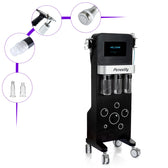
- Fixed room, back-to-back bookings → 8-in-1 stand-type. A workflow choice, not a stronger-results choice.
- Consultation-led clinic → 7-in-1 AI skin analysis. Only if you use the output in intake.
"Budget" means total launch cost, not the sticker price: delivery, training, workspace preparation, opening supplies, cleaning products, insurance and marketing all sit outside the device price. A cheap unit without reliable consumables costs more than a mid-tier unit with a dependable supply chain. For a line-by-line launch budget see the small-salon setup checklist; for service-pricing arithmetic see the equipment cost and salon ROI guide.
What should you compare before choosing a model?
Attachment count is the least useful number on a spec sheet. Compare what changes your workflow and cost per appointment. These are selection criteria, not performance claims — suction levels, tip counts, certifications and warranty terms must be confirmed on the product page and manual for the exact model ordered.
| Dimension | What to ask | Why it matters |
|---|---|---|
| Functions you will use | Which modes actually ship in this configuration? | Sets the trainable, priceable menu; unused functions add cost, not revenue |
| Consumable compatibility | Which bottles, tips, and filters, at what current cost and lead time? | Drives variable cost per session; AS1/SA2/AO3 are the site's three-bottle solution set, which is compatible with all Surebeauty hydro dermabrasion machines |
| Footprint & utilities | Power, drainage/fluid handling, cable routing, clean vs used storage | Decides whether it fits a compact or shared room |
| Cleaning workload | How long does flushing, disinfecting and container care take? | Cleaning time caps appointments per day |
| Warranty, returns & support | Written warranty, returns policy entry point, repair shipping | Determines the real cost of downtime — ask, do not assume |
Cleaning is not overhead you can ignore: flushing fluid lines, disinfecting reusable parts and disposing of single-use items belong in the booking schedule. Training is not optional simply because a certificate may not be required locally — whether a device is regulated depends on its intended use (FDA, Aesthetic (Cosmetic) Devices), and local professional requirements vary. Confirm the rules before accepting bookings.
How do the Surebeauty models line up on verified 2026 pricing?
Prices below were verified against the listings on 2026-11-14. Every figure is "as listed on the product page, subject to change" — confirm the live price for the exact configuration before ordering; these are not quotes. Installment figures, bundle contents, specifications and shipping terms are not reproduced here because they must be read from the live product page.
| Model | Verified price (2026-11-14) | Typical fit |
|---|---|---|
| 6-in-1 compact | $239.00 — as listed on the product page, subject to change | First machine; solo/mobile; basic hydro dermabrasion |
| 8-in-1 compact (desktop) | $329.00 — as listed on the product page, subject to change | Small salon; broader function set on a counter |
| 7-in-1 with LED face mask | $295.00 — as listed on the product page, subject to change | Adding a phototherapy upsell |
| 7-in-1 with AI skin analysis | $999.00 — as listed on the product page, subject to change | Consultation-led, report-based positioning |
| 8-in-1 stand-type (vertical) | $1,249.00 — as listed on the product page, subject to change | Fixed room; back-to-back throughput |
| AS1/SA2/AO3 solution set | $27.99 — as listed on the product page, subject to change | Recurring consumable; compatible with all Surebeauty models |
A higher price reflects function integration, build and form factor, not better outcomes.
How should you think about cost and payback — without guarantees?
"How many treatments until it pays for itself?" has no responsible single answer: it depends on pricing, booking volume, consumable cost and fixed overheads that a device-price calculation ignores. Use a worksheet instead of a promise. The formula used consistently across this site is:
payback (weeks) = device price ÷ [sessions per week × (price per session − consumables per session − variable cost per session)]
Worked example — illustrative only. Every figure is a sample assumption, not a Surebeauty price other than the device, and not a forecast of your results: device price (6-in-1) $239.00, as listed on the product page, subject to change; price per session $100; consumables per session $8; other variable cost per session $12; 8 sessions per week. Weekly contribution = 8 × ($100 − $8 − $12) = $640. Device price ÷ weekly contribution = $239.00 ÷ $640 ≈ 0.37 weeks.
What clinical and safety boundaries should a buyer know?
A small randomized study of 20 women reported increased epidermal/papillary dermal thickness and skin antioxidant levels after a six-treatment series, with improvements in fine lines, pores and pigmentation; a separate imaging study saw transient erythema over 2–5 days. These are small, exploratory studies of the technique category, not evaluations of any specific device; results are temporary and vary by individual (Freedman, J Cosmet Dermatol 2008; PMID 19146604; Razi et al., Skin Res Technol 2024; DOI 10.1111/srt.13684). Broader reviews call improvement "mild but definite," note limited evidence for acne and pigmentation change, and ask for better-designed trials (Microdermabrasion: reappraisal, Dermatol Surg 2006; PMID 16792646; Microdermabrasion: an evidence-based review; PMID 20048628).
Frequency. Common protocols are 4–6 sessions spaced 2–4 weeks apart, adjusted to skin type, response and operator assessment; research used 6 sessions at 7–10 day intervals, while AAD describes 5–16 sessions for microdermabrasion at roughly weekly-or-longer spacing (Freedman, J Cosmet Dermatol 2008; PMID 19146604; AAD, Microdermabrasion: FAQs).
Aftercare. Transient pinkness, tightness and mild swelling are common, so "no redness / zero downtime" is inaccurate. AAD notes microdermabrasion pinkness usually settles within about a day; the imaging study above reported 2–5 days of visible erythema after mid-intensity treatment (AAD, Microdermabrasion: FAQs; Razi et al., Skin Res Technol 2024). Clients should use gentle moisturizer, broad-spectrum SPF≥30 with reapplication, avoid sun and irritating actives, and contact a clinician if burning, itching or swelling worsens.
When to postpone or refer. Recent isotretinoin use (past 6 months), growing/bleeding/changing lesions, keloid history, active infection, open wounds or herpes flare, active rosacea or inflammatory acne flares, pregnancy or breastfeeding (safety data insufficient), and allergy to solution ingredients (AAD, Microdermabrasion: FAQs; AAD, Chemical peels: FAQs; AAD, Is any acne treatment safe to use during pregnancy?). Build this into your consultation form.
Regulatory language. Never claim FDA approval or certification for any device. Regulation depends on intended use (FDA, Aesthetic (Cosmetic) Devices); a 510(k) clearance is substantial equivalence, not effectiveness approval (FDA, 510(k) Clearances); dermabrasion devices are generally Class I and 510(k)-exempt in many cases under 21 CFR 878.4820 / 878.4800 — a classification, not a clearance certificate for a specific model (FDA, 21 CFR 878.4820). FDA and AAD sources here support general mechanism and safety information only, not product endorsements.
What does total cost of ownership include beyond the device price?
Three layers: initial setup (device, delivery, training, workspace, opening supplies); per-appointment variable costs (solutions, disposables, treatment/cleaning labor, payment fees); ongoing overheads (rent, marketing, insurance, servicing). Add maintenance and hygiene — replacement filters, tubing and tips, approved cleaning products and their contact times, and cleaning downtime between clients.
Which common buying mistakes should you avoid?
Neutral checks, without sweeping claims:
- Price alone — weigh total launch cost, consumable supply and support responsiveness; confirm what ships in the box.
- Warranty and returns — ask for written terms, the returns policy entry point, repair arrangements and shipping responsibility.
- Solution compatibility — confirm exact bottles, tips and seals and their cost and lead time; do not assume universal fit.
- Unofficial channels — prefer the official store or an authorized seller with a formal invoice and accessible support.
- Training — complete relevant training and check local professional requirements before accepting bookings; a demonstration is not a substitute for assessment, contraindication screening and hygiene.
Frequently Asked Questions
Which hydro dermabrasion machine is best for a small salon on a tight budget?
The 6-in-1 compact ($239.00, as listed on the product page, subject to change) or 8-in-1 compact ($329.00, as listed on the product page, subject to change) — then confirm included handpieces and solution compatibility. "Best" means lowest capital at risk for one trainable service, not a results claim. See the small-salon setup checklist.
Can I use my own serums, and what do they cost?
Yes, you can use your own serums with Surebeauty hydro dermabrasion machines. Serum costs vary by brand and formulation. Alternatively, Surebeauty’s AS1/SA2/AO3 three-bottle solution set is compatible with all Surebeauty hydro dermabrasion machines and is listed at $27.99, subject to change. Include your chosen serums or solutions in your per-session consumable costs.
How many sessions until a client sees results, and how often should they book?
No fixed number. Common protocols are 4–6 sessions spaced 2–4 weeks apart, adjusted to response; effects are temporary, vary by individual, and the studies are small (Freedman, J Cosmet Dermatol 2008; PMID 19146604; AAD, Microdermabrasion: FAQs). Explain that results vary.
What is the device's regulatory status, and who should not be treated?
No device should be described as having FDA approval of effectiveness — regulation depends on intended use and 510(k) is substantial equivalence, not an approval of effectiveness (FDA, Aesthetic (Cosmetic) Devices; FDA, 510(k) Clearances). Postpone or refer clients with recent isotretinoin use, changing lesions, keloid history, active infection or open wounds, active inflammatory flares, pregnancy/breastfeeding, or solution allergies (AAD, Microdermabrasion: FAQs; AAD, Is any acne treatment safe to use during pregnancy?). See the side effects and contraindications guide.
Where to go next
Read hydradermabrasion vs microdermabrasion and the hydro dermabrasion pillar guide for mechanism and aftercare. For the full worksheet, see the equipment cost and salon ROI guide; for launch readiness, the small-salon setup checklist. Browse the hydro dermabrasion machine collection for live configurations.


0 comments