

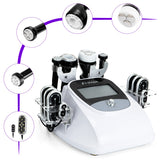


Cavitation machine price by budget tier: a side-by-side comparison
The table uses listed prices verified for this guide as configuration examples, not a claim about what every machine costs. Confirm the live figure before committing a budget.
| Listed price | Representative configuration | Nominal frequency | Setting it is built for |
|---|---|---|---|
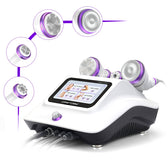
| $198 | 3-in-1 40K home cavitation machine — three combined functions, compact footprint | 40K | One user, one routine |
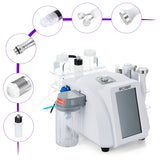
| $599 | 30K S Shape 2.5 professional cavitation machine — S Shape platform, professional tier | 30K | Solo esthetician or small treatment room |
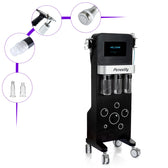
| $950 | 6-in-1 30K S Shape cavitation machine with 160mW lipo laser — six combined functions, adds a 160mW laser handpiece | 30K | Advanced spa with a broader service menu |
Read the frequency column as a protocol identifier, not a quality score. The next section explains what each tier adds.
What changes between the $198, $599 and $950 configurations
Three things change with the price: the number of functions in one chassis, the handpiece format, and the intended setting.
At $198, the 3-in-1 40K unit is a compact, single-operator machine with one nominal frequency and three functions. For a treatment room, that limits the service menu and the settings to document between clients. One handpiece does most of the work, so turnover depends on how quickly you can clean and reset it.
At $599, the 30K S Shape 2.5 is professional equipment. The S Shape format changes how the applicator is worked across an area, and the unit is built for repeated use on clients. This is the tier where staff training and a written protocol matter: more than one person may operate it, and inconsistent passes show up in client records.
At $950, the 6-in-1 30K S Shape configuration adds a 160mW lipo laser handpiece to the same 30K platform. The gain is menu breadth, not a claim that one modality is stronger. More handpieces also mean more items to clean, more settings to log, and more parts that can fail between bookings.
For the S Shape model comparison, see the S Shape buyer's guide. For document and warranty checks at any tier, see how to choose a cavitation machine.
Total cost of ownership: gel, handpieces and downtime
The listed cavitation machine price is the entry cost. Three recurring lines decide what the machine costs to keep in service.
Coupling gel. Ultrasound needs a wet layer between the handpiece and skin; without it, energy is reflected at the surface and the pass becomes uncomfortable. Gel is a consumable, not a fat-loss active ingredient. Budget for it per session and check the manufacturer's recommended water-based formulation before stocking up — the cavitation gel guide explains the ingredient logic. A unit with more handpieces does not automatically use more gel, but a busier schedule does.
Handpieces and spares. Transducer faces wear, and a professional unit that loses its main handpiece loses its working function until a replacement arrives. A replacement 30K handpiece is listed at $115; confirm compatibility for your own model before ordering. Keep one spare on hand if the machine carries a full client schedule, and record which handpiece is assigned to which setting so a swap does not reset your protocol.
Downtime and service. Ask about warranty terms, who covers shipping on a return, and whether a loaner or spare is available. A lower purchase price can be erased by a week out of service. Build a short daily check — transducer face, leads, gel layer, user log — into opening procedure so faults are caught before a client appointment.
No payback figure is projected here. Service-side pricing belongs in the cavitation treatment pricing guide; this article stays with equipment cost.
Reading the frequency label on a cavitation machine price
The 30K and 40K figures are nominal working frequencies in kilohertz: how fast the transducer oscillates, not power or an efficacy grade. Higher frequency means a shorter wavelength and shallower energy distribution; there is no clinical evidence that one figure gives a better outcome. The 30K vs 40K vs 80K guide covers the physics. When machines otherwise match, let the manual, handpiece count and service terms decide.
The evidence boundary behind every cavitation machine price
A higher price does not move a machine outside the evidence boundary that applies to non-invasive body contouring.
The FDA guidance on non-invasive body contouring states that these technologies do not treat obesity, do not produce weight loss, may give only temporary improvement and commonly require multiple treatments; it also lists pain, redness, swelling, bruising and nodules among reported complications. These devices do not carry an FDA marketing authorization for fat reduction.
A 2025 review of ultrasound-induced lipolysis reports average waist reductions of 0.5–3.12 inches, while stating that the metabolic fate of liberated lipids remains unclear (PMID: 40943608; DOI: 10.3390/ijms26178689). A separate review describes non-invasive outcomes as far short of liposuction (PMID: 26566568). Neither figure is a result to promise a client. The AAD describes results as subtle relative to liposuction and recommends dermatologist assessment before cosmetic procedures (AAD, non-invasive fat removal guidance); it also states there is no evidence that ultrasound alone reduces cellulite (AAD, cellulite treatments guidance).
Regulation is a second place where a price tag misleads. The 21 CFR 878.4590 focused ultrasound classification covers a focused-ultrasound stimulator system for aesthetic use — a Class II medical device category, not the non-focused, low-frequency portable machines discussed here. Treat that classification as context, not as a credential attached to a spa unit. For the mechanism itself, see the ultrasonic cavitation overview that explains the technology behind any cavitation machine price.
A short note on the home-class tier
The $198 3-in-1 40K unit also works as a personal device. For personal use, priorities shift to manual clarity, one comfortable handpiece, storable gel and a place to keep the unit. Follow the manual's protocol, keep the gel layer wet, and record settings so a second session repeats the first. The home-use cavitation machine guide covers that setting. A home device is for one user, not for offering sessions to others.
FAQ
No. Price reflects functions, handpieces and build, not a clinical outcome. The evidence boundary is the same across tiers: non-invasive contouring does not produce weight loss and results may be temporary (fda.gov).
Count the functions and handpieces you will actually schedule, then add gel, spares and service terms. The 160mW laser on the $950 unit adds a modality to the menu; it does not make the cavitation handpiece stronger.
Coupling gel per session, a spare handpiece for the model you run, and a contingency for downtime. Confirm warranty and return-shipping terms before purchase.
No. The AAD states there is no evidence that ultrasound alone reduces cellulite, and the FDA guidance describes improvement as potentially temporary.
The manual defines the intended setting and operator. Home-class units are built around one user; professional units assume a treatment-room workflow and staff training.
Where to go next
- Browse all cavitation machines — current models and live prices.
- The home vs salon verification checklist — documents, warranty and gel questions to raise before a purchase.


0 comments