

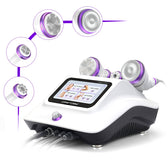
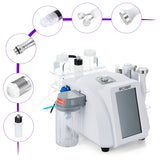
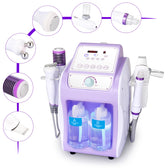
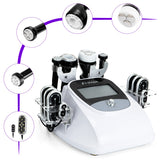


What an ultrasonic cavitation machine actually does
Three parts do the work: a generator, a handpiece holding a piezoelectric transducer, and a coupling medium. The gel matters because air trapped between the handpiece and skin reflects ultrasound almost completely; a water-based gel removes that air gap and reduces the impedance mismatch. Once the energy is in tissue, the mechanical effect of bubble collapse — cavitation — is what the name refers to.
The most frequently cited mechanistic evidence is histological rather than clinical. Bani and colleagues examined human skin and adipose tissue after ultrasound-induced cavitation and reported structural changes in adipocytes (PMID: 25289235; DOI: 10.1097/GOX.0b013e3182a7f222). That establishes a plausible biological effect. It does not establish how many centimetres a given person will lose, or how long any change lasts.
The numbers printed on these units — 30K, 40K, 80K — are nominal operating frequencies in kilohertz, not power ratings and not a ranking of results. They are covered in the 30K vs 40K vs 80K frequency guide; this page deliberately stops at the definition.
| Question | Short answer |
|---|---|
| Is it surgery or injections? | No. Nothing is inserted and no tissue is removed. |
| Is it a weight-loss treatment? | No. Regulators state that body contouring does not treat obesity and does not produce weight loss. |
| Is it the same as focused ultrasound? | No — see the regulatory section below. |
| Does the gel reduce fat? | No. It is a coupling medium, not an active ingredient. |
What the evidence does — and does not — support
The honest answer to "does ultrasonic cavitation work?" is that some measurable, temporary change in circumferential measurements has been reported, but the evidence base is small, heterogeneous and does not support strong claims.
A 2025 literature review in the International Journal of Molecular Sciences reports average waist circumference reductions of 0.5–3.12 inches after three sessions across the studies it examined (PMID: 40943608; DOI: 10.3390/ijms26178689). The same review states that it remains unclear whether the liberated lipids are oxidised for energy, re-esterified into new fat depots, or excreted. That matters: a confident claim about fat being flushed out through the lymphatic system and liver overstates what is known (PMID: 40943608).
Two authoritative boundaries matter more than any headline number:
- The FDA non-invasive body contouring guidance (fda.gov) states that these procedures do not treat obesity, do not result in weight loss, may produce only temporary improvement and commonly require multiple treatments. It also lists pain, redness, swelling, bruising and palpable nodules among reported complications.
- The American Academy of Dermatology describes results from non-invasive fat removal as subtle compared with liposuction, notes that ultrasound-based protocols in medical settings typically involve one to three treatments, and states there is no evidence that ultrasound alone reduces cellulite (AAD, non-invasive fat removal and cellulite guidance).
| Evidence point | Defensible wording | Wording to avoid |
|---|---|---|
| 0.5–3.12 in waist change after 3 sessions (PMID: 40943608) | "Studies report modest, variable circumference changes" | "Three inches in three sessions" as a promise |
| Ortiz & Avram 2015 (PMID: 26566568) | "Results do not approach liposuction" | "Comparable to liposuction" |
| FDA guidance (fda.gov) | "Not a weight-loss treatment; results may be temporary" | A licensed fat-reduction claim for this device category |
| AAD cellulite guidance | "No evidence ultrasound alone reduces cellulite" | "Removes cellulite" |
Where the regulatory line sits
This is the part most often misquoted. Federal regulation 21 CFR 878.4590 defines a "Focused Ultrasound Stimulator System for Aesthetic Use" as a device using focused ultrasound to produce localised mechanical motion within tissues and cells, for localised heating or mechanical cellular membrane disruption, and classifies it as Class II with special controls (21 CFR 878.4590; eCFR, .gov). The operative word is focused. Portable 30K, 40K and 80K spa and home units are non-focused, low-frequency devices — a different category, not a smaller version of that classified system.
Accordingly, this category of portable equipment does not carry a marketing authorisation for fat reduction, and nothing on this site should be read as one. The FDA guidance also asks prospective users to read the device manufacturer's information and discuss personal risk factors with a health care provider (fda.gov). Treat that as a purchasing requirement rather than a footnote: request the documentation before you buy, and check it against the unit that actually ships.
Terminology to keep straight: a 510(k) clearance applies to a specific device and indication, not to a technology category. If a listing uses clearance language without naming the device, ask for the document.
What this means in a treatment room
For a salon or spa, the practical questions are operational: client intake and consent language, staff training, appointment length, utilisation, and what happens when a handpiece fails mid-week. Warranty terms, service turnaround and consumable availability belong in the purchasing file alongside the device itself. For a concrete professional example, the Aristorm 30K S Shape machine is the highest-volume cavitation model in our recent sales data; use it as a checklist exercise rather than a recommendation.
Build the consultation script around the evidence boundary: describe a modest, variable change in measurements rather than a promised outcome; record baseline measurements the same way at every visit; and make clear that maintenance sessions may be needed. The AAD's description of subtle results relative to liposuction is useful calibration for those conversations (AAD, non-invasive fat removal guidance). For the consumable side of the workflow, see the cavitation gel ingredient and usage guide; for how this modality compares with another common option, see the laser lipo versus cavitation comparison.
A home user can apply the same evidence boundary to a compact unit: results, if any, are variable and temporary, and no home device is a weight-loss tool. The home vs salon verification checklist sets out the documents and warranty terms to confirm before buying.
What to check before any session
Because this is a device category rather than a single authorised product, the safety checklist lives in the manufacturer documentation and in a clinician's assessment:
- Read the manufacturer's contraindications and the labelling on the unit that arrives. The FDA guidance specifically tells prospective users to review device manufacturer information and discuss personal risk factors with a health care provider (fda.gov).
- Contraindication lists — implanted electronic devices, pregnancy, broken skin or active infection in the treatment area — are commonly found in manufacturer manuals. Verify them against the manual shipped with your unit rather than assuming any list here is complete. The AAD recommends assessment by a board-certified dermatologist before cosmetic procedures (AAD, cellulite and fat removal guidance).
- Keep the coupling gel in place for the whole pass. A dry handpiece drags, warms the surface and defeats the coupling layer.
- Record the frequency and settings used so each session is reproducible.
FAQ
Some studies report modest, variable reductions in waist circumference after a short series of sessions (PMID: 40943608; DOI: 10.3390/ijms26178689), while reviews conclude the effect does not approach liposuction (PMID: 26566568). A possible temporary change in measurements is defensible; a predictable outcome is not.
No. The FDA guidance states that non-invasive body contouring does not treat obesity and does not result in weight loss (fda.gov). A promise about a number on the scale describes something this category does not do.
No. The AAD describes non-invasive results as subtle relative to liposuction, and Ortiz and Avram concluded these devices do not yet approach surgical results (PMID: 26566568; AAD, non-invasive fat removal guidance).
No. 21 CFR 878.4590 covers focused ultrasound stimulator systems (eCFR, .gov). Portable 30K, 40K and 80K units are non-focused, low-frequency devices. See the regulatory section above.
There is no universal protocol for portable equipment. The AAD's one-to-three-session figure refers to ultrasound treatment in a medical setting (AAD, non-invasive fat removal guidance). For a home or spa unit, follow the protocol in the manufacturer's manual.
The FDA guidance lists pain, redness, swelling, bruising and palpable nodules among reported complications (fda.gov).
Where to go next
- Best Ultrasonic Cavitation Machines for Home Use — a buyer's guide limited to devices under $300.
- How to Choose a Cavitation Machine — the full verification checklist, including certification documents, warranty and training.
- Browse the cavitation machine collection — all current models in one place.


0 comments