

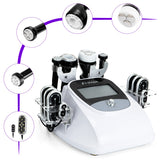

Here is the short version. The suction figure tells you the maximum vacuum the pump can generate. It does not tell you how well the diamond tip removes surface skin, how deep the treatment goes, or what result you will get. A higher number is not a higher grade of exfoliation. Understanding why — and what to check instead — will save you from paying for a spec that does not change your outcome.
What the suction number actually measures
Centimetres of mercury (cmHg) and kilopascals (Kpa) are both units of pressure difference. On a microdermabrasion machine they describe how strong a vacuum the device can pull at the handpiece. That is a real, measurable property of the pump.
What it is not is a dose of treatment. Microdermabrasion exfoliates because an abrasive tip is drawn across the skin and the vacuum lifts away the loosened cells. The result depends on the tip, the pressure you apply, the speed of your passes and how many times you go over an area — not on the pump's peak rating. A machine advertised at 68 cmHg does not automatically exfoliate "more" than one at 55 cmHg; the tip and your technique matter more than the headline figure.
If you want the underlying mechanism — the diamond tip and vacuum working together as a superficial abrasion — the fundamentals guide covers it in full.
Why listings turned a pump spec into a selling point
The number caught on because it is easy to compare and it sounds clinical. A buyer cannot easily judge tip quality or build quality from a photo, but everyone can see that 80 is bigger than 60. Sellers leaned into that, and soon the ranking pages were sorted by suction figures with phrases like "professional strength" attached.
The problem is that no primary source supports the leap from "higher vacuum" to "better result." Search the dermatology literature and you will not find a trial showing that a home device at 68 cmHg produces a better cosmetic outcome than one at 55 cmHg. What you find instead are guidance documents about what the procedure does and what its side effects are. The evidence reviews for this category are modest about results in general, which is a long way from the certainty of the ranking pages.
Treating the suction number as a result scale is a marketing convention, not a clinical one.
The real cost of pushing suction too high
More vacuum is not free. The AAD lists the possible side effects of microdermabrasion as including bruising, burning and stinging, and notes that people who scar or pigment easily carry more risk (AAD microdermabrasion FAQs). Stronger suction and more aggressive passes increase the chance of exactly those reactions, especially on thin or sensitive skin.
Two consequences matter for a home user:
- Irritation sets back your schedule. The skin barrier needs time to recover after microdermabrasion — a review puts that recovery on the order of 48 hours in the studied setting (PMC4155739). Overdoing suction does not speed results; it just extends the time your skin needs to settle before the next session.
- Redness is not proof of a deeper treatment. A post-session flush is a response to abrasion and suction, not evidence that you reached a deeper layer. Chasing redness by raising the setting is how people turn a gentle treatment into an irritated one.
This is why "start at the lowest comfortable setting and increase only as tolerated" is standard advice across manuals and professional guidance, while "max out the vacuum" appears mainly in sales copy.
What to look at instead of the peak number
If the suction figure is a weak signal, what should you check? These are the specs and features that actually change the experience:
| What to check | Why it matters |
|---|---|
| Adjustable suction range | Lets you start low and build tolerance; a single fixed high setting is a limitation |
| Tip material and included grits | The abrasive tip does the exfoliation; available grits change how gentle or assertive a pass feels |
| Vacuum consistency | A pump that holds steady during a pass is more useful than a high peak that fluctuates |
| Cleanability of tips and filter | Reusable tips must be cleaned between uses; a hard-to-clean design is a hygiene problem |
| Clear instructions and stop criteria | Home devices need explicit guidance on session length and when to stop |
Notice that none of these is a single bigger-is-better number. They are about control and fit to your skin — which is the honest way to judge a home exfoliation device.
A practical way to use this at home is to treat the first few sessions as a calibration exercise rather than a treatment target. Note the setting you started at, how your skin felt during the pass, and how it looked the next morning. If you saw prolonged redness or tightness, the setting or the number of passes was too high for that session — the answer is to step back, not to push through. If you felt almost nothing and your skin looked unchanged, the issue is far more likely to be tip pressure and pass technique than the pump's peak rating. Keeping a short note of setting, pass count and next-day response tells you far more about the right setting for your skin than any figure on a box.
This is also why a machine with a wide adjustable range is more useful than one with a single impressive maximum: the range lets you find your own working level, while the maximum only tells you the ceiling you hopefully never need. For how these features line up on real machines and prices, see the machine comparison.
Suction on a home device versus a professional unit
It is worth separating two things that marketing blurs. Professional resurfacing systems can generate stronger suction because they are built and operated differently — often with trained oversight, controlled settings and a clinical setting. A portable home kit is a cosmetic device sold for superficial exfoliation, not a cleared medical device (eCFR 21 CFR 878.4820).
So a home machine advertising a high cmHg figure is not thereby reproducing a professional treatment. The enclosure, the operator's training and the aftercare are part of what a salon provides; a suction number cannot substitute for them. A salon can also adjust settings to the person in front of them and stop immediately if skin reacts; a home user working from a fixed box figure has none of that feedback. The home versus salon guide draws that boundary carefully.
One more reason to read the number with care: cmHg and Kpa describe the same physical quantity in different units, so 1:1 comparisons across listings are only meaningful when the unit matches. Sellers know that most buyers do not convert between them, which is part of why the figure works so well as a headline. Treat it as one specification among several, and give more weight to whether the machine lets you control the suction you actually use.
FAQ: common suction questions
Is 68 cmHg better than 55 cmHg? Not by itself. The number is the pump's maximum vacuum, not a measure of result. Tip, technique and setting choice matter more.
What unit should I compare — cmHg or Kpa? They measure the same thing in different units. Pick one and compare like with like; do not treat a bigger number in one unit as inherently stronger.
Will higher suction remove blackheads better? Surface debris, yes, a stronger vacuum may lift more. Deep follicular plugs are a different problem that surface suction does not reliably solve.
Can I hurt myself with too much suction? You can increase irritation, bruising and stinging. The AAD flags these side effects, and people who scar or pigment easily should be especially careful (AAD microdermabrasion FAQs).
How often should I use the device? Follow the unit's instructions and give your skin time to recover between sessions. Our frequency and expectations guide explains why a fixed weekly number is not a rule for everyone.
Where to go next
- For the mechanism behind the tip and vacuum, read Diamond Microdermabrasion Explained.
- For real machines and prices judged on functions rather than suction, see Diamond Microdermabrasion Machines Compared.
- For the contraindications that matter before you raise a setting, open Who Should Not Use a Diamond Device.
The devices this spec appears on are collected in our diamond microdermabrasion collection, with tips and filters listed separately.


0 comments